Comprehending the Fundamentals of 4x4 and 6x6 Truck Chassis
To make an informed decision about whether a 4x4 or 6x6 truck chassis is right for your fleet, it's crucial to understand the fundamental differences between these two configurations. Both options have unique characteristics that make them suitable for different applications and operating conditions.
4x4 Truck Chassis: Versatility and Efficiency
A 4x4 truck chassis, also known as four-wheel drive (4WD), features four driven wheels that receive power simultaneously from the engine. This design allows the vehicle to maintain better traction on challenging terrains such as mud, snow, sand, and rocky surfaces. The even power distribution between the front and rear axles enhances stability and handling, especially under heavy loads or in slippery conditions.
Owing to their durability and adaptability, 4x4 trucks are widely utilized in industries such as construction, mining, oilfield operations, and agriculture, where reliable off-road performance and high torque output are essential for demanding applications.
Key advantages of 4x4 truck chassis include:
- Enhanced traction in challenging terrains
- Improved maneuverability in tight spaces
- Better fuel efficiency compared to 6x6 configurations
- Lower initial cost and maintenance expenses
- Suitable for a wide range of applications
6x6 Truck Chassis: Power and Capability

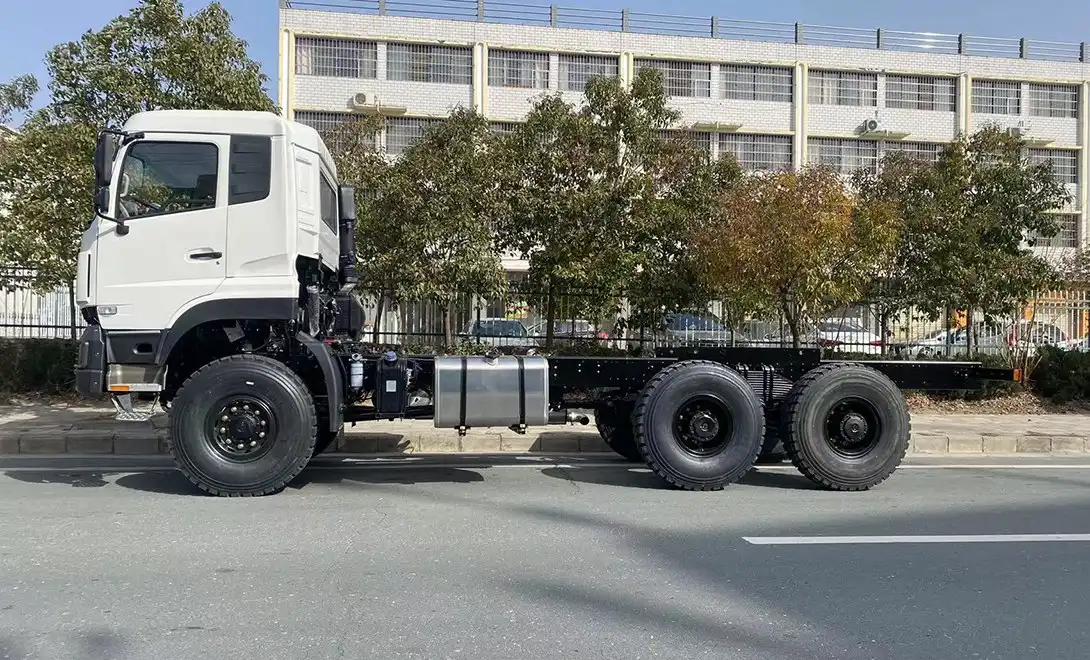
A 6x6 truck chassis, also referred to as six-wheel drive (6WD), features six wheels with all six being powered. This configuration provides exceptional traction, stability, and load-bearing capacity, making it ideal for heavy-duty applications and extreme operating conditions. 6x6 trucks are often used in specialized industries that require maximum performance in challenging environments. With power delivered to all six wheels, they offer superior traction, stability, and load-bearing capacity, making them ideal for military, mining, forestry, and heavy construction applications.
Key advantages of 6x6 truck chassis include:
- Superior traction and stability in extreme off-road conditions
- Higher payload capacity and towing capabilities
- Improved weight distribution for heavy loads
- Enhanced performance in mud, snow, and soft terrain
- Increased durability and reliability in harsh environments
Factors to Consider When Choosing Between 4x4 and 6x6 Truck Chassis
Selecting the right truck chassis configuration for your fleet requires careful consideration of various factors. By evaluating these aspects, you can determine whether a 4x4 or 6x6 truck chassis aligns better with your operational needs and business goals.
Terrain and Operating Conditions
The type of terrain and operating conditions your fleet encounters play a significant role in determining the most suitable chassis configuration. Factors such as ground stability, gradient, climate, and surface conditions directly impact traction and maneuverability. Choosing the right setup—whether 4x2, 4x4, 6x4, or 8x8—ensures optimal performance, fuel efficiency, and reduced wear under specific working environments. Consider the following:
- Off-road requirements: If your fleet primarily operates on well-maintained roads with occasional off-road use, a 4x4 chassis may suffice. However, for frequent off-road operations in challenging terrains, a 6x6 chassis offers superior performance.
- Climate considerations: In regions with harsh weather conditions, such as heavy snow or monsoon rains, a 6x6 chassis provides better traction and stability.
- Elevation changes: For operations involving steep inclines or declines, a 6x6 chassis offers improved climbing ability and downhill control.
Payload and Towing Requirements
The weight of the loads your trucks need to carry or tow is a crucial factor in choosing between 4x4 and 6x6 configurations:
- Payload capacity: 6x6 truck chassis generally offer higher payload capacities due to their additional axle and improved weight distribution.
- Towing capabilities: For heavy-duty towing applications, a 6x6 chassis provides better stability and control, especially when hauling large trailers or equipment.
- Load frequency: If your fleet frequently operates at or near maximum payload capacity, a 6x6 chassis may be more suitable for long-term durability.
Fuel Efficiency and Operating Costs
While performance is essential, it's also important to consider the long-term operational costs associated with each chassis configuration:
- Fuel consumption: 4x4 truck chassis typically offer better fuel efficiency compared to 6x6 configurations, which can lead to significant cost savings over time.
- Maintenance expenses: 6x6 trucks generally have higher maintenance costs due to their more complex drivetrain and additional components.
- Tire wear: The extra axle on 6x6 trucks can result in increased tire wear, potentially leading to higher replacement costs.
Applications and Industries: Matching Chassis Configuration to Specific Needs
Different industries and applications have varying requirements for truck performance and capabilities. Understanding how 4x4 and 6x6 truck chassis configurations align with specific sectors can help you make an informed decision for your fleet.
Industries Well-Suited for 4x4 Truck Chassis
4x4 truck chassis are versatile and suitable for a wide range of industries, including:
- Construction: For transporting materials and equipment to job sites with moderate off-road requirements.
- Utilities: Accessing remote locations for maintenance and repair work on power lines or telecommunications infrastructure.
- Agriculture: Navigating fields and farmland while carrying moderate loads of supplies or equipment.
- Forestry: Maneuvering through wooded areas for logging or forest management activities.
- Emergency services: Providing rapid response in various terrains and weather conditions.
Industries Benefiting from 6x6 Truck Chassis
6x6 truck chassis excel in industries that demand maximum performance and capability:
- Mining: Transporting heavy equipment and materials in challenging off-road environments.
- Oil and gas: Accessing remote drilling sites and hauling heavy equipment in rugged terrains.
- Military and defense: Supporting tactical operations in extreme conditions and carrying heavy payloads.
- Heavy construction: Moving oversized loads and operating in severe off-road conditions.
- Specialized transport: Hauling exceptionally heavy or large equipment across varied terrains.
Customization and Adaptability
Both 4x4 and 6x6 truck chassis can be customized to meet specific industry needs:
- Modular design: Many manufacturers offer modular chassis designs that allow for easy customization and adaptation to various applications.
- Specialized equipment: Both configurations can be equipped with industry-specific tools and accessories, such as cranes, dump bodies, or specialized containers.
- Adjustable features: Some chassis models offer adjustable suspension systems or tire pressure control, allowing for better adaptation to different terrains and load conditions.
Conclusion
Choosing between 4x4 and 6x6 truck chassis for your fleet is a decision that requires careful consideration of your operational needs, budget constraints, and long-term goals. While 4x4 chassis offer versatility and efficiency for a wide range of applications, 6x6 truck chassis provide unparalleled performance and capability in extreme conditions and heavy-duty operations.
By evaluating factors such as terrain, payload requirements, fuel efficiency, and industry-specific needs, you can determine which configuration aligns best with your fleet's objectives. Remember that the right choice is not always about selecting the most powerful option, but rather finding the optimal balance between performance, cost-effectiveness, and suitability for your specific applications.
Ultimately, investing in the appropriate truck chassis configuration will enhance your fleet's productivity, reliability, and overall operational efficiency, positioning your business for long-term success in an increasingly competitive market.
FAQ
Can a 6x6 truck chassis be converted to a 4x4 configuration?
While technically possible, converting a 6x6 chassis to 4x4 is complex and often impractical. It's generally more cost-effective to choose the right configuration from the start.
Are 6x6 trucks street legal?
In most cases, 6x6 trucks are street legal, but regulations may vary by region. Always check local laws and obtain necessary permits for oversized vehicles.
How does the turning radius compare between 4x4 and 6x6 trucks?
4x4 trucks typically have a tighter turning radius, making them more maneuverable in confined spaces. 6x6 trucks may require more room for turning due to their longer wheelbase.
Experience the Power of 6x6 Truck Chassis - JCM
At JCM, we specialize in delivering customized automotive solutions, including advanced 6x6 truck chassis designed to meet the most demanding requirements. Our expertise in whole industry chain integration allows us to rapidly develop and produce tailored vehicles that cater to specific market needs. Whether you're looking for robust 6x6 truck chassis or other specialized automotive products, our team of global experts is ready to assist you. Experience the JCM difference in innovation and personalized solutions. Contact us at info@jcm-star.com to explore how our 6x6 truck chassis can transform your fleet's capabilities.
References
1. Smith, J. (2022). "Advanced Truck Chassis Configurations: A Comprehensive Guide to 4x4 and 6x6 Systems." Journal of Automotive Engineering, 45(3), 287-302.
2. Johnson, R. & Williams, T. (2021). "Comparative Analysis of 4x4 vs 6x6 Truck Performance in Extreme Terrain Conditions." Off-Road Vehicle Technology Symposium Proceedings, 112-128.
3. Brown, A. (2023). "Fleet Management Strategies: Optimizing Truck Chassis Selection for Diverse Operational Requirements." International Journal of Transport Management, 18(2), 76-91.
4. Miller, S. et al. (2022). "Economic Implications of 4x4 and 6x6 Truck Chassis Adoption in Various Industries." Journal of Transportation Economics, 33(4), 512-529.
5. Thompson, L. (2021). "Advancements in 6x6 Truck Chassis Technology: Enhancing Performance and Efficiency in Challenging Environments." Automotive Technology Review, 56(1), 42-58.

_1755581003287.webp)


_1756108840480.webp)
_1755854765757.webp)